
Hoopscotch, submarines and Learning Through Play!

The game is called Hoopscotch - Hopscotch with hoops, and my girls took to hula hooping so quickly that I had to add another layer to the game to keep it interesting. They had to perform a trick while finishing the hoopscotch!
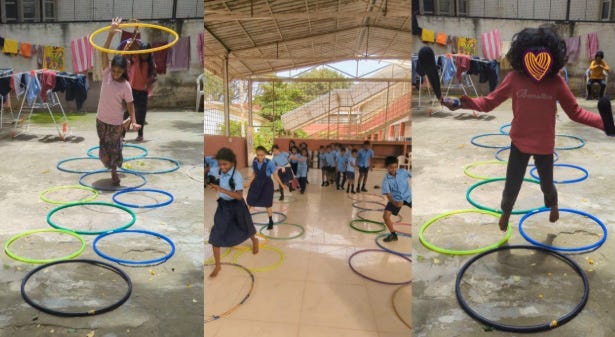
This session was conducted back in June 2024. For about 2.5-3 years, I just kept conducting pilots for Spinfinity. It made me believe/realise its power, but my highly neuronic brain still struggles to communicate it. I was told so many times to articulate the WHY of what I do. I think I might have lost out on some opportunities just because I couldn’t do that in one sentence. Sit with me for 15 minutes and I can tell you, but that one line answer will make me melt into myself.
Two months ago, I got a scholarship from Aishwarya Nair to attend her Advanced Toy Design and Play Theory course. It gave me some super useful tools to help articulate Spinfinity’s “value”. Usually impact metrics and frameworks make me feel like what Spinfinity is gets reduced, but this particular one—Learning Through Play—was quite powerful! And it made the analysis more objective, rather than it feeling like anecdotal evidence built on my experience as a facilitator.
Let me take you through this framework and show you how I used it to analyse my girls’ hoopscotch experience!
Learning Through Play Toolkit
The Learning Through Play toolkit is built by The Lego Foundation. Here’s how they describe it: “We say learning through play happens when the activity
(1) is experienced as joyful,
(2) helps children find meaning in what they are doing or learning,
(3) involves active, engaged, minds-on thinking,
(4) involves iteration (experimentation, hypothesis testing and problem solving), and
(5) is socially interactive.”
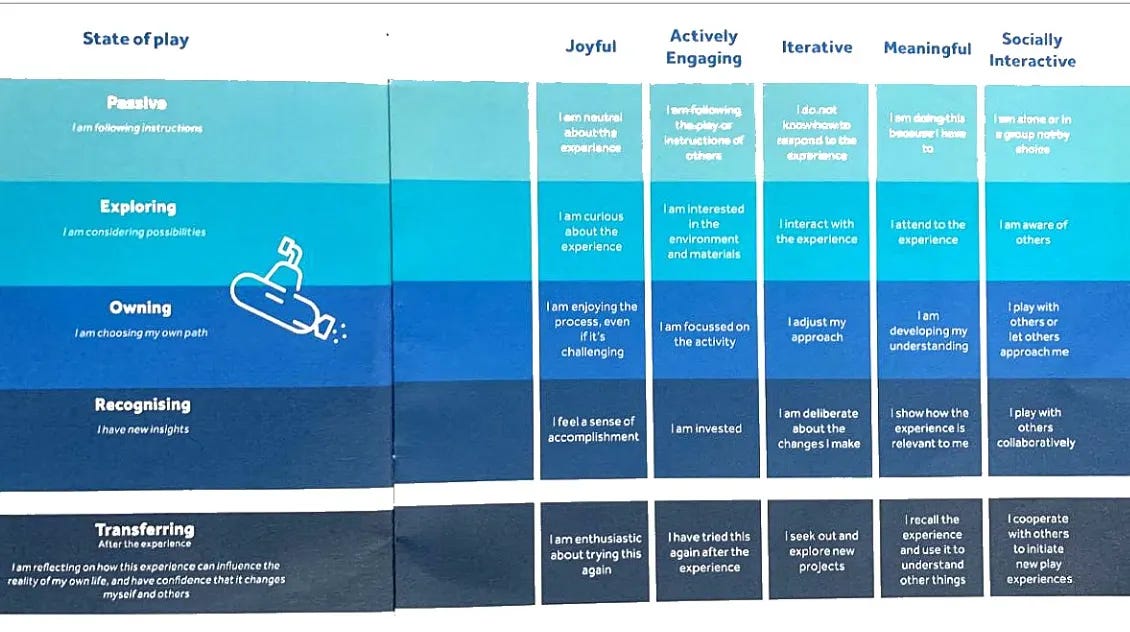
Okay yes, so far it might sound like it’s just listing a bunch of relevant characteristics that make learning playful. But just wait for the Experience Tool! With it, they’ve created descriptions of what the five experiences might look and feel like from the child’s perspective! You can make a behavioural coding using this.
For each characteristic, there are five states of play:
Passive: I am following instructions,
Exploring: I am considering possibilities,
Owning: I am choosing my own path,
Recognizing: I have new insights
Transferring (Post experience): I am reflecting on how this experience can influence the reality of my own life, and have confidence that it changes myself and others
This is how it comes together as a matrix:
The Submarine Metaphor
My favourite part of this is the submarine metaphor. The goal isn’t for kids to reach the deepest level as fast as possible. Developing and practicing skills takes time. Like a submarine on a deep sea mission: sometimes you need to come up for air!
How easy it is to forget this! At least for me. In the past few years of piloting, I have been so caught up with trying to pack in all the elements of Spinfinity (hula hooping, math, embodied problem solving, expression). It took me two years just to realise that all of these elements took me 20 years of hula hooping to learn, grow and love. (I’m writing about this parallelly, a blog post called fractal perfectionism is incoming!)
LTP in Spinfinity - Sneha
Here’s how I used the Learning through Play toolkit on videos of two of my students Sneha and Shakti (names changed).
Sneha’s I-statement: I am Sneha. I am 6 years old. Today, Aditi Akka arranged hula hoops and asked us to skip through them. This game is called hoopscotch! While jumping, we also had to do any trick. My favourite prop is poi, so I did poi and jumped through the hoops! I felt so much Joy as I jumped through all the hoops effortlessly! I have the biggest smile on my face!
This is the behavioural coding I did for her. I have to hide her face to protect her privacy, so you sadly can’t see her big proud smile as she finishes the race. But I think her body language gives it away too!
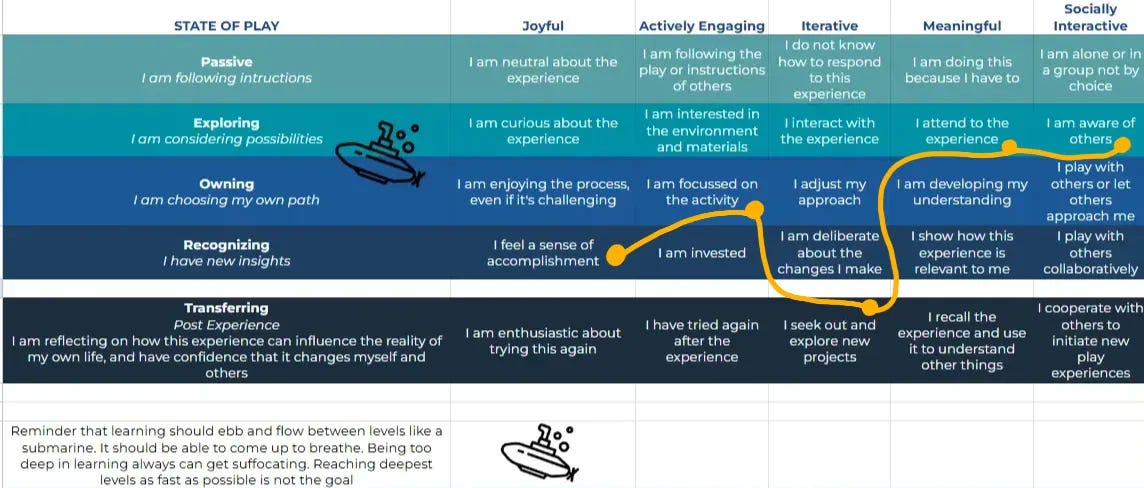
For Joyful, Sneha is clearly in the Recognizing state. Her wide smile and excitement at the end of the sequence signal a sense of accomplishment.
Moving to Actively Engaging, she demonstrates the Owning state. She’s deeply focused as she coordinates both jumping and spinning, fully absorbed in the challenge she has set for herself.
In terms of Iterative, Sneha shows evidence of the Transferring state. Her eagerness to try again and experiment with new variations indicates that she is already thinking ahead to future play opportunities. (not visible in this video, but after this she was super excited to do the challenge again)
For Meaningful, Sneha can be seen in the Exploring state. The play becomes personally relevant because she connects it to her love of poi and attends carefully to how the two movements—jumping and spinning—fit together.
Finally, under Socially Interactive, she is in the Exploring state. She is aware of her peers watching and cheering her on, which contributes to her enthusiasm, even though her focus remains on her own play.
When I first did the coding, I was trying so hard to make her experience seem “deeper” especially because of how smoothly she does it! But the submarine in the chart is a reminder that this is more than enough, and that kind of joy is not easy to spark.
LTP in Spinfinity - Shakti
Next comes Shakti! Here’s her I-statement: I am Shakti. I am 8. Today I played hoopscotch with a hula hoop. In my first try, I could not spin and jump at the same time, so I just held the hoop and finished. On my second try, I did a little better. On my third try, I spun for more jumps but had to hold the hoop in the last two. On my last try, I changed my angle, and I did it! I kept trying again and again, made small adjustments each time and finally succeeded iteratively!
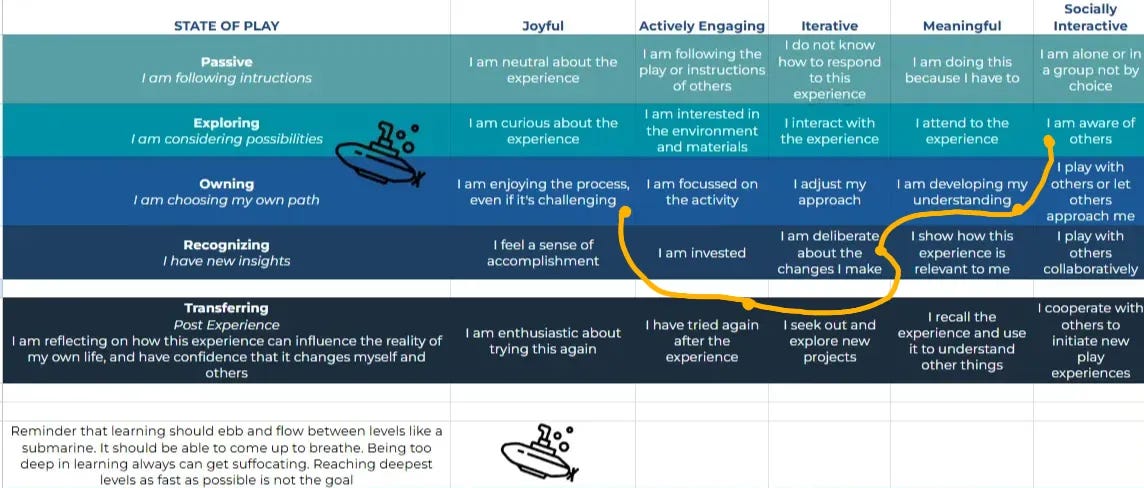
Shakti shows enjoyment through her persistence despite initial struggles. She celebrates small improvements and engages deeply with the challenge, demonstrating a sense of ownership over her progress.
Her repeated attempts and willingness to refine her approach indicate that she is actively transferring learning from one try to the next. She experiments with different angles and strategies, showing engagement beyond a single experience.
Shakti carefully observes what works and what doesn’t, adjusting her technique with each attempt. This deliberate process reflects a recognition of her own learning and growing skill.
She connects each attempt to her understanding of balance, timing, and movement. By reflecting on her performance and modifying her actions, she demonstrates meaningful learning and personal growth.
While Shakti is focused on her own iterative practice, she remains aware of her peers around her and interacts within the shared play environment, showing an exploratory engagement with social dynamics!
Closing Reflections
The reason I say Spinfinity is embodied problem solving is because of this iterative quality, where the kids voluntarily push themselves to keep trying and come up with ways to solve puzzles that the body also plays a role in. Now with this framework, I can exactly qualify these moments. Shakti’s journey of approaching the task she set for herself from different angles (pun intended) makes her more confident in her abilities, because she herself came up with the solutions too.
That’s been my first experience with the learning through play toolkit! I’m inspired by how the framework is designed, because it embodies a metaphor (I know that these and gestures are super important for embodied cognition, but haven’t gone deeper into it yet), and strengths the story. I’ve only used it for past videos until now, so I’m excited to see how it plays (pun intended again) out when I design for/with it.
And thank you for reading this far! I’m still figuring out if this kind of writing is for Substack. I was looking for a space where my brain can run a million miles an hour without having to concise-ify it for algorithms and attention spans. Maybe this is it! I’d love to hear your thoughts and feedback.
Yooo, so much of the elements you look at for play is the same as being in the flow state! Which fully makes sense actually because both are addressing a similar experience. Also on the length of your post - I think 4 mins is perfect 🙌